

Considering that I haven’t posted in a while, I thought I should briefly cover a topic deeply important to the Journalist profession and then relate it to my story.
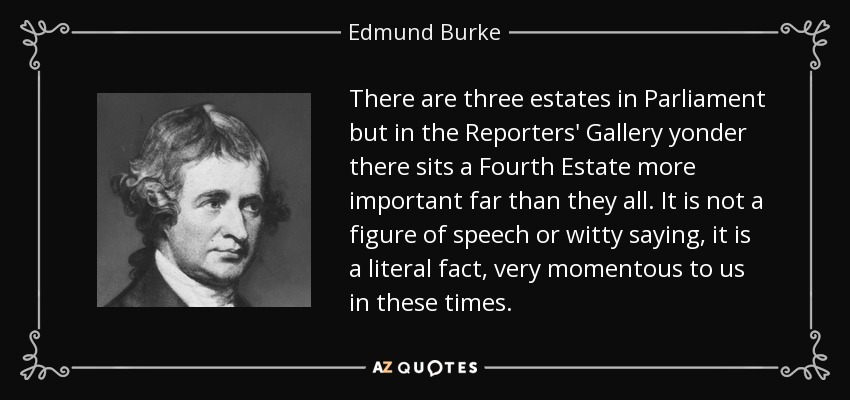
Journalistic integrity is inherently linked to the idea of Journalist acting as watchdogs, monitoring and publicizing the activities of people in power. A perfect illustration of this idea came in the late 18th century when Edmond Burke referred to the press as the “fourth estate . . . contrasting it with the three Estates of the Realm in France” (Allan, 2012, p. 3). In modern times, the autonomy of the press relates to an ideal where journalist are independent of commercial and state influence. However, skeptics are concerned that this ideal is not lived up to because of commercialisation and concentration of ownership in the media which leads to conflicts of interest and the distortion of the truth.
The Web 2.0 revolution has provided a platform for independent journalists who are not constrained by draconian editorial policies. This means that anyone with a smartphone and access to the internet is able to contribute to the public discussion. However, Burum and Quinn (2016) are concerned that the opportunities provided by user based content do not necessarily equate to a sustainable productive public sphere. They propose that journalist should be equipped with a set of skills involving “a more holistic, thoughtout, mobile digital story-telling form called mojo” which can “provide a countervailing force against a high level of precarity in society” (Burum, Quinn, 2016, p. 40)
For me and my story, I am not concerned about commercial and state influence because I’m writing as an independent. This means that I’m in an optimal position to question previous and current decisions by the council on behalf of the Piha community. Having access to the internet and social media through my smartphone also means that I can publish content quickly and efficiently.
At the end of the day though I realise that having a sufficient toolkit is only part of the process when it comes to telling a story. In order to give my story its due credit, I must utilise the concepts and theory taught in this paper.
Allan, S. (2012). The Routledge companion to news and journalism. London: Routledge.
Burum, I., & Quinn, S. (2016). MOJO: the mobile journalism handbook: How to make broadcast videos with an iPhone or iPad. New York: Focal Press.

